
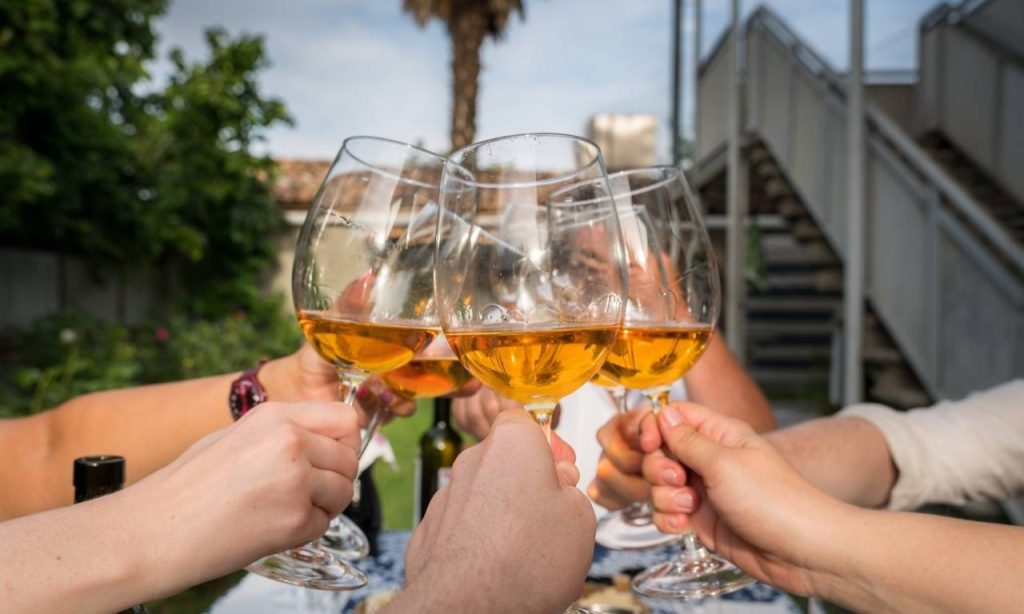

A Georgian wine revolution is happening right now, and that’s a good thing. A recent trip to Georgia confirmed it! Let me share my first-hand experience.
INTRODUCTION TO THE REBIRTH OF GEORGIAN WINE.
At one time, over 1,000 indigenous grape varieties grew in Georgia to produce Georgian wine. The Russians arrived in 1921 and took control of the country, including winemaking. Unfortunately, fine wine was not part of their Russian heritage, so production was restricted, varieties homogenized, and the vintners were requested to make very sweet, strong wine in large quantities for the masses. This was what the Russians preferred. With many varietals no longer required, the number of indigenous grape varieties dropped from 1,000+ to less than 500.
The Russians left in 1991—unfortunately, not permanently. Since then, the Georgians have revived their heritage of making fine wines using a traditional method that is thousands of years old. They have been winning prizes at International wine competitions. Georgian wines are firmly back on the world’s wine map!

Georgia, the “Cradle of Wine.”
“Georgia is the cradle of wine.” You hear this over and over in Georgia, and it is not some slogan thought up by a public relations company on Madison Avenue in New York City. There is scientific evidence to prove it.
In 2017, an international team of archaeologists examined broken pottery shards found at Gadachrili Gora and Shulaveri Gora, two Stone Age villages near Tbilisi. The shards revealed traces of wine believed to date back to the Neolithic period, about 8000 BC. They also found indications that wine was produced on a large scale in and around these villages as early as 6000 BC and was being made in large oval-shaped clay vessels, very much the same as it is made today in Qvevri.
The research was based on spectrometry, a reliable scientific process that was used to detect wine residues on broken clay vessels. The vessels also had grape decorations, further suggesting that wine was made there.
Proceedings of the National Academy of Sciences (PNAS) – a publication with worldwide recognition – published this reliable research, which National Geographic later republished.
VISITING KAKHETI, THE HEART OF THE GEORGIAN WINE COUNTRY.
Kakheti, the major wine region in Georgia, can easily be reached by car from the capital of Tbilisi, which takes less than two hours. The roads in Georgia are good, and there are also freeways and more freeways under construction, mostly all built by the Chinese. The Chinese are building roads, railroads, and ports “everywhere.” Dare I say, in Georgia, the Chinese are rebuilding the Old Silk Road, which of course, they will control because they planned the road system!
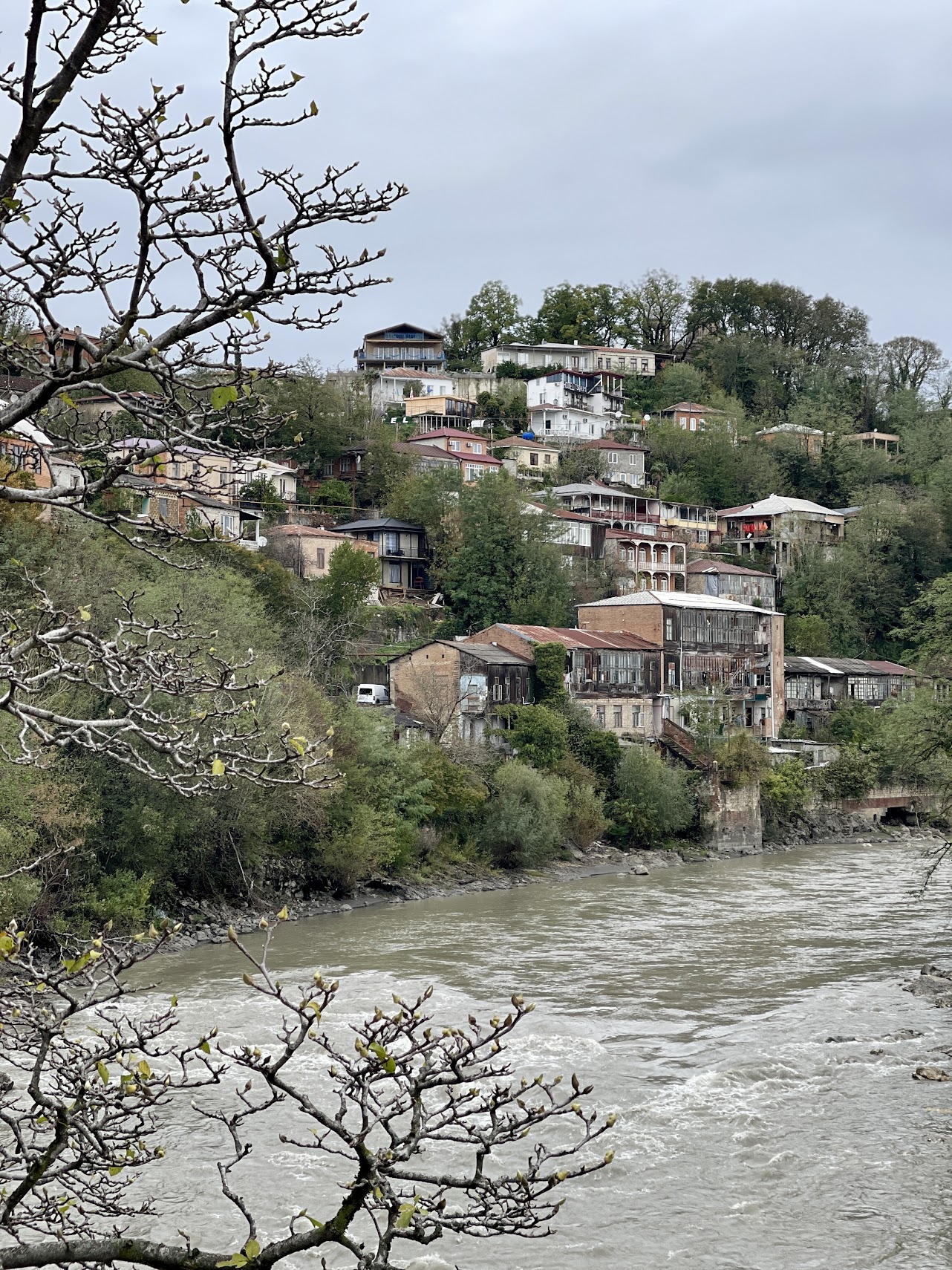
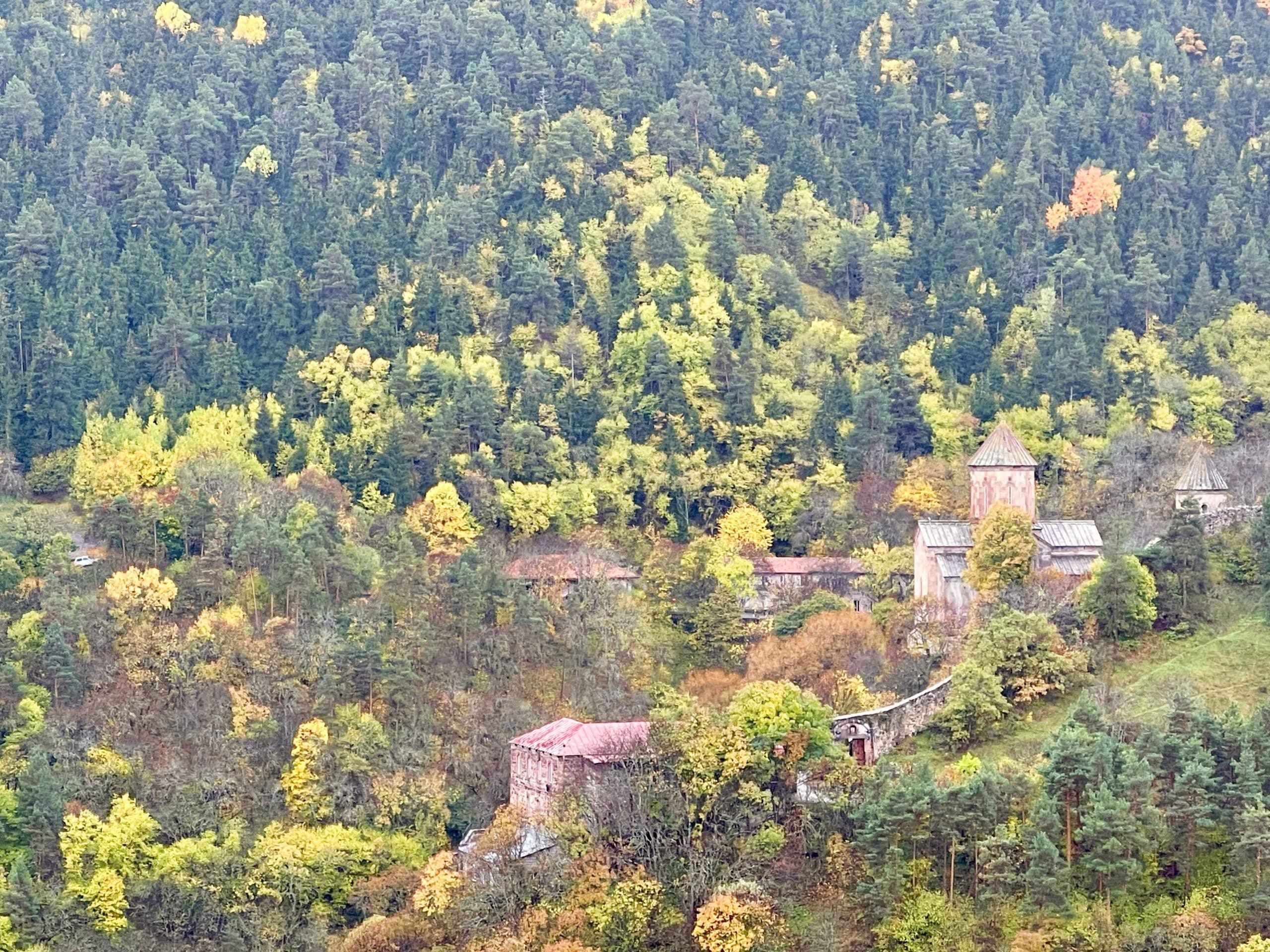
It is a constantly changing scene of gurgling rivers, cascading waterfalls, farmsteads, and medieval monasteries and churches, some dating back to the 6th century BC. The scenery is gorgeous, including the leafy forest and mountainous of the Gombori Pass.
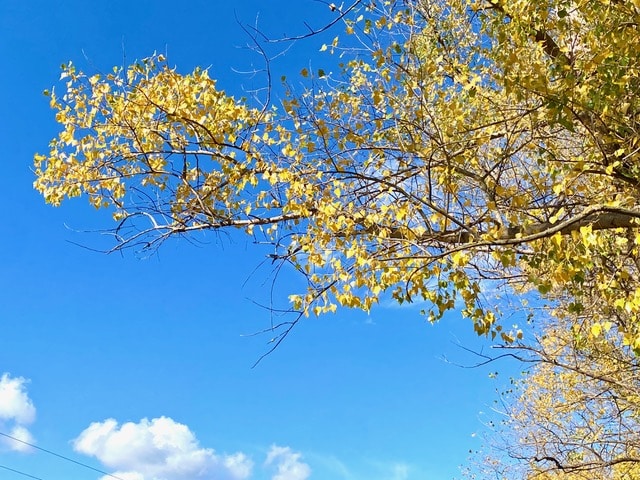
I traveled during October, at what must have been, by chance, the peak week for autumn leaves. It was panoramic, driving past hillsides saturated with a palette of golden colors as the leaves magically changed from palest cream to buttercup yellow and burnt ochre when they were ready to fall off the trees.
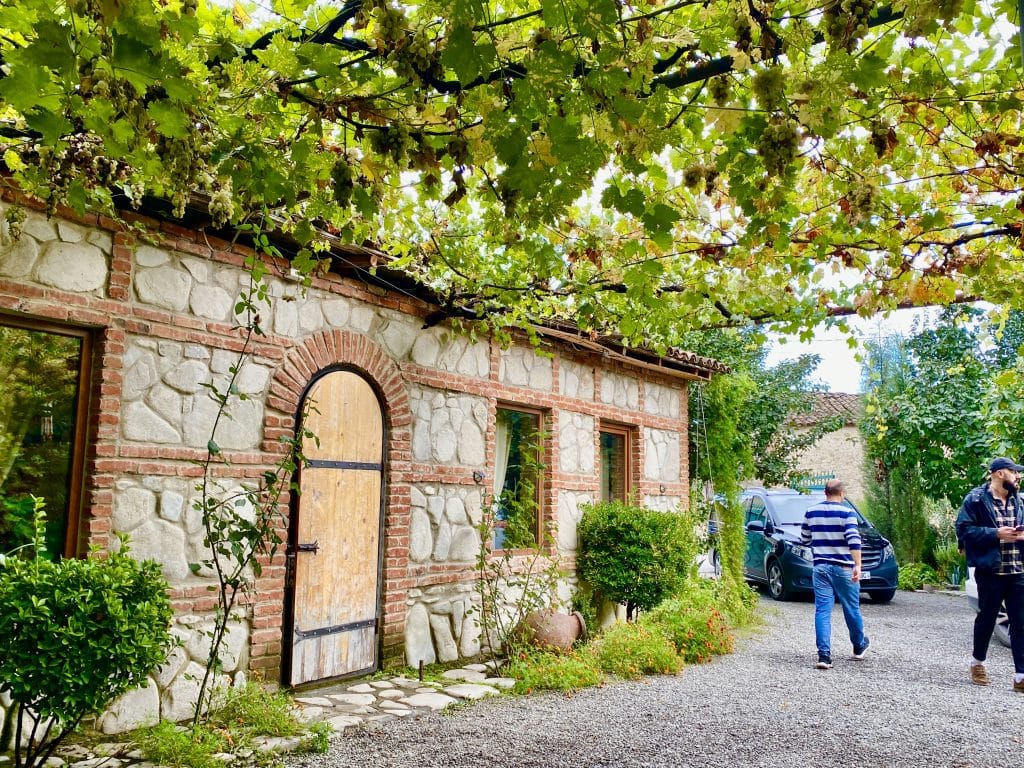
As we approached the wineries, the architecture changed. It became uniform, signaling that we had arrived in the Kakheti Georgian wine region. While many houses in the country are built of stone, Kakheti has a distinct style. Stone gathered from the hillsides is cut into workable sizes and divided into sections using rows of red bricks. Once you see the houses with outlines of red bricks and hillsides covered with grape vines, you will know you are in Kakheti! This is the heart of Georgian wine country.
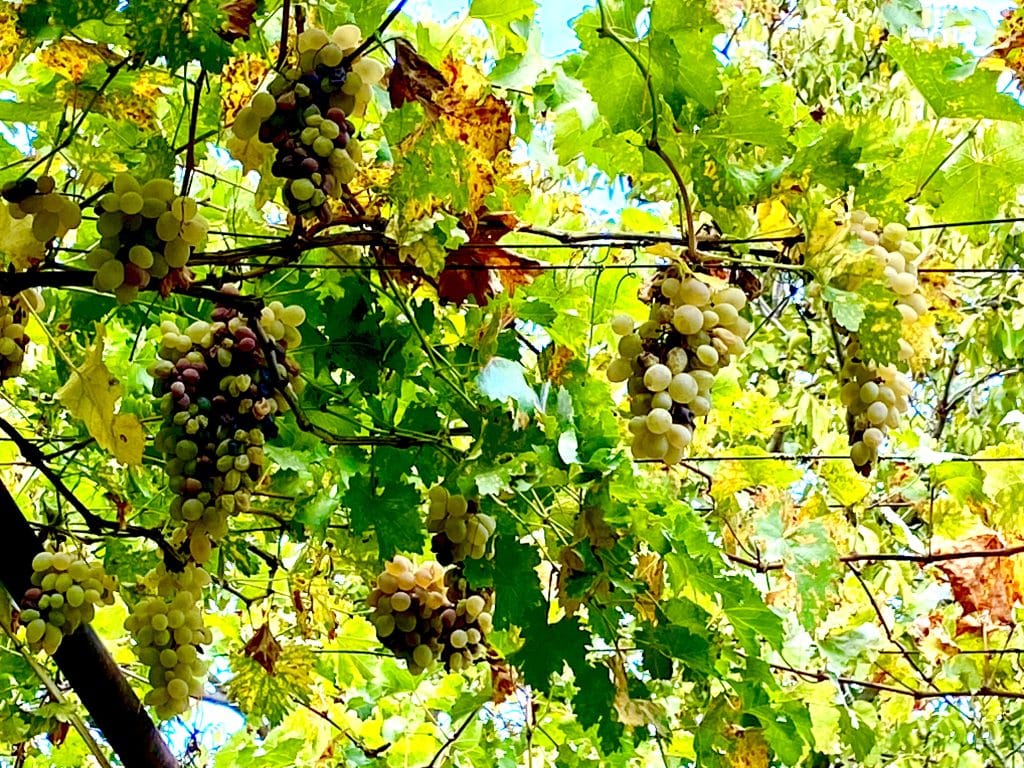
It was fall, and the vines were heavy with grapes. Their leaves began to shrivel, a sure sign that the grapes were ripe.
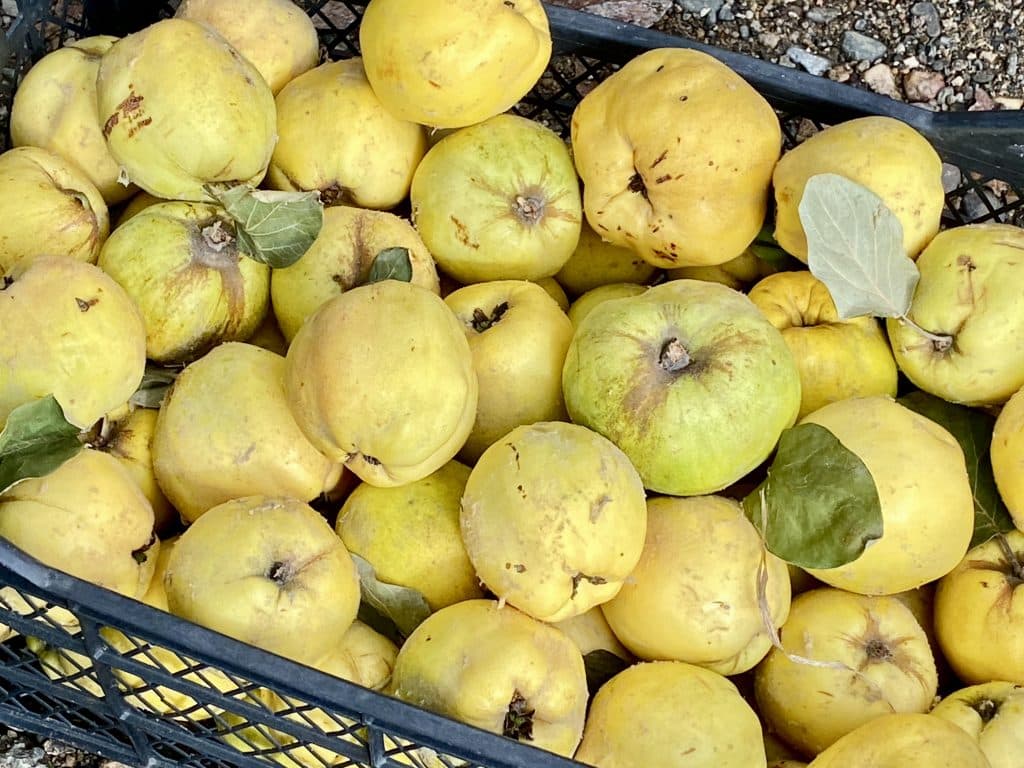
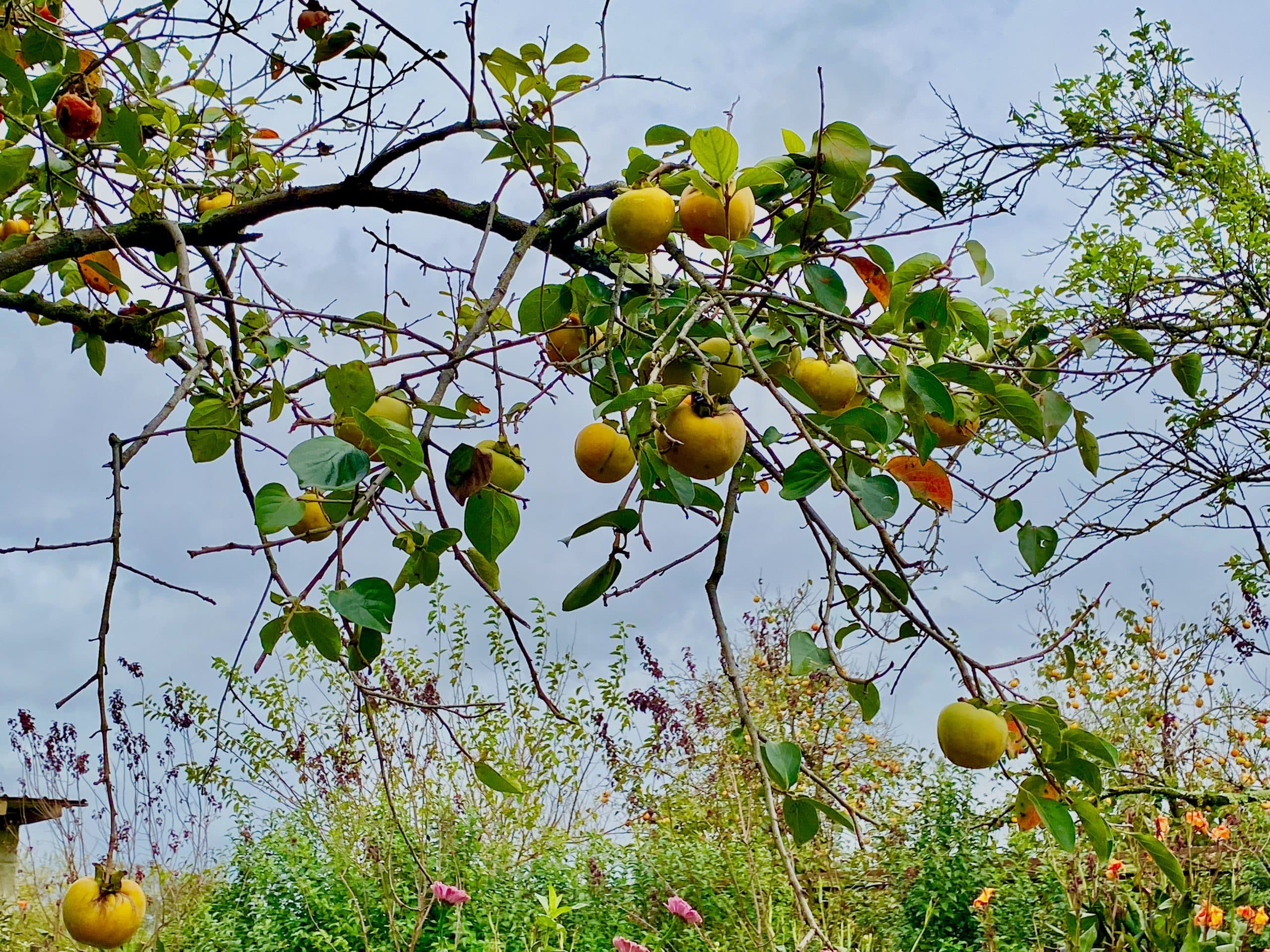
Each house had workable land, enough for a fruit and vegetable garden, a few chickens, and the occasional cow. We saw ripe pears, apples, persimmons, quinces, pomegranates, grapes, and walnuts. In fact, walnuts feature prominently in Georgian cuisine. They are crushed until they form a paste and are used extensively in sauces and dips instead of cream – and they are far healthier! It was truly wondrous, and I would love to return in the spring when the fruit trees are in blossom. Wishful thinking!

Georgia has ten wine regions, with Kakheti being the largest, producing 70% of Georgia’s wine. This amounts to 136 acres of vineyards plus individual households that produce “in-house” wine, made from whatever grape varietal is growing in their garden. Many varietals that were thought to have disappeared during the Russian era were found in people’s home vineyards, being slowly added back into production.
Kakheti is less humid than the other wine regions and possesses several microclimates and terroirs, which account for the wine diversity produced there.
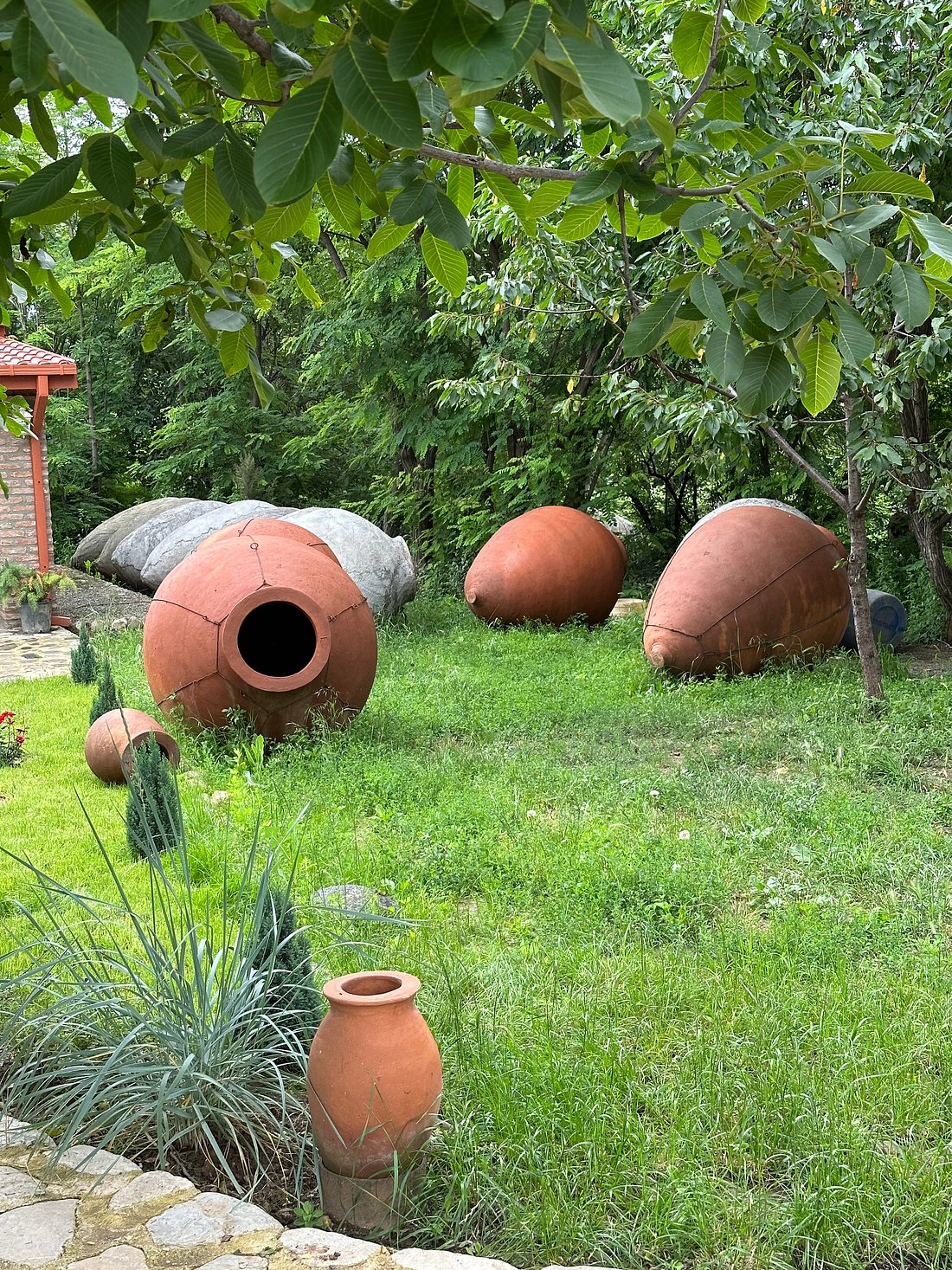
QVEVRI
The qvevri has been the cornerstone of the Georgian winemaking process. It is an inherent part of Georgian life and culture, with many rituals. Wine in Georgia is not just a drink. It is a way of life and a window into the heart and soul of the Georgian people.
An oval clay amphora, called a qvevri, is central to traditional Georgian winemaking. This method dates back 8,000 years. The entire wine-making process, from grape pressing to wine fermentation and storage, takes place in the qvevri, which is buried underground and maintains a constant temperature during fermentation.
It is this traditional winemaking process that gives Georgian wines their unique texture, consistency, and palette.
The wine produced in qvevri imparts a very different flavor and character to wine made in oak barrels or steel tanks.
My friends and I had a guided tour of the winemaking process initiated by Eat This! Tours. This a local tour company that leads some of the most creative and interesting wine and food tours in Georgia. You can read more about that experience here.
GEORGIAN WINE.
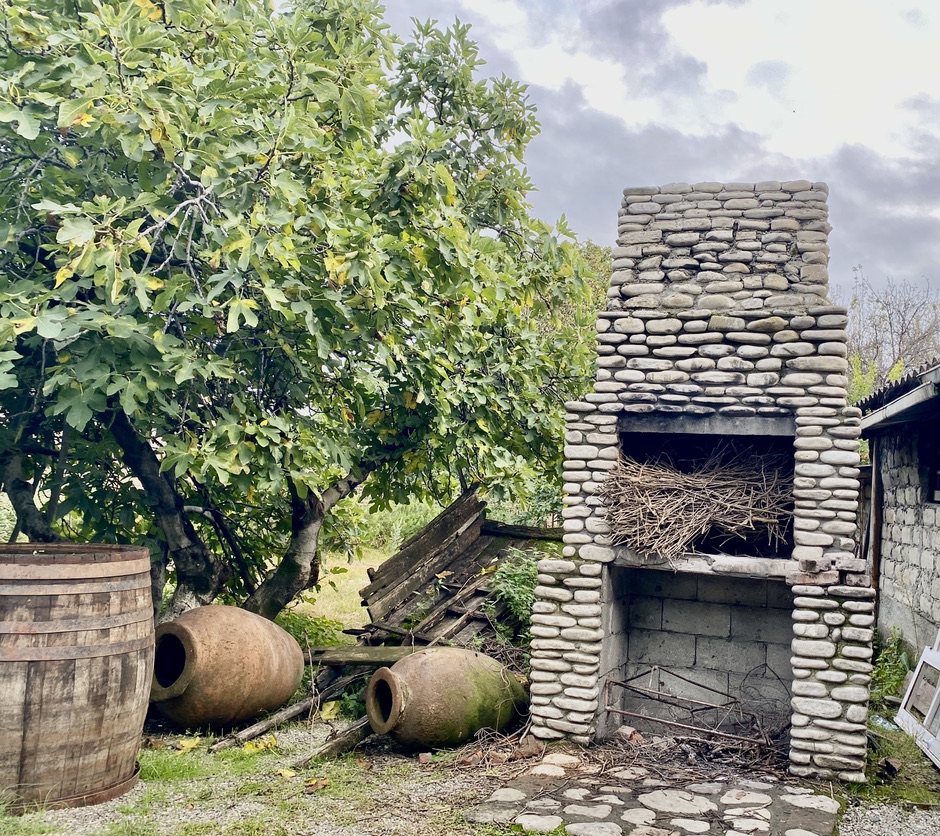
THE ART OF MAKING QVEVRI.
Qvevri are handmade by artisans who are masters of their craft – a craft passed down through generations and requires extreme skill. In all of Georgia, there are presently only eight places where artisans are still making these clay vessels. Because of their scarcity, there is a waiting period of two years for the new qvevri. For these eight families still involved in making qvevri, it is a shared occupation that can also include the neighbors participating. Children are inducted into the art of qvevri making when they are toddlers and will learn the craft at their father’s side by being included in the “team.” This is a male-dominated occupation requiring great strength and stamina, leaving the women free to dominate in the kitchen! That’s nothing new in this part of the world!
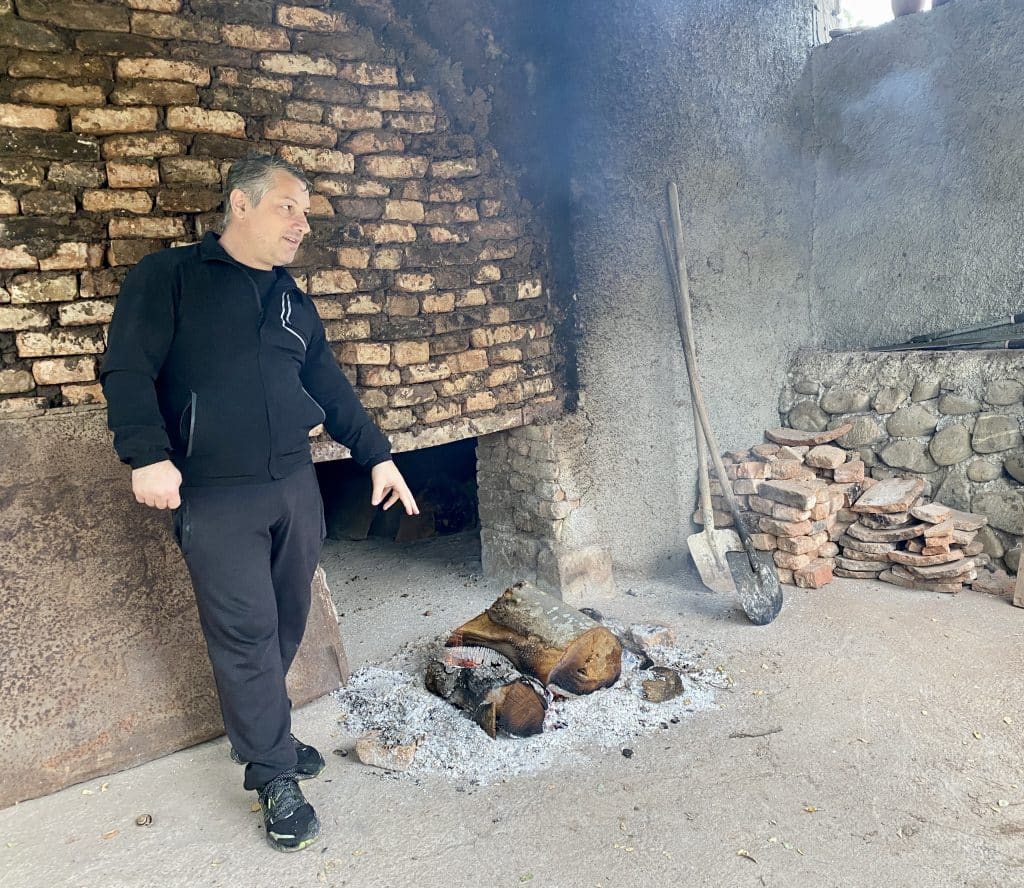
VISITING A QVEVRI MAKER.
One of the most fun parts of traveling with Eat This! Tours was visiting people’s homes, showcasing families connected to Georgian wine culture. One of our visits was to Zaza’s home, a qvevri maker who lives in the Kahketi wine region. After being introduced to Zaza, we found out he is one of the eight surviving Georgian qvevri “masters.”
Gathering around Zaza in the room where he fires the qvevri, he describes qvevri making to us in detail. Well, sort of, because he explained it to Tsotne, our interpreter and guide, in Georgian, and Tsotne translated it to us in English. It was easy to follow, even without speaking Georgian, because everything was in front of us, and with a show of the hands, we did not even need language.
We went inside the “studio” and stood in front of the furnace in his “factory.” The factory is not the right word because each qvevri is handmade and is a work of art and skilled engineering. This is not engineering that is written on a piece of paper. It is eye-balled and comes with years of experience.
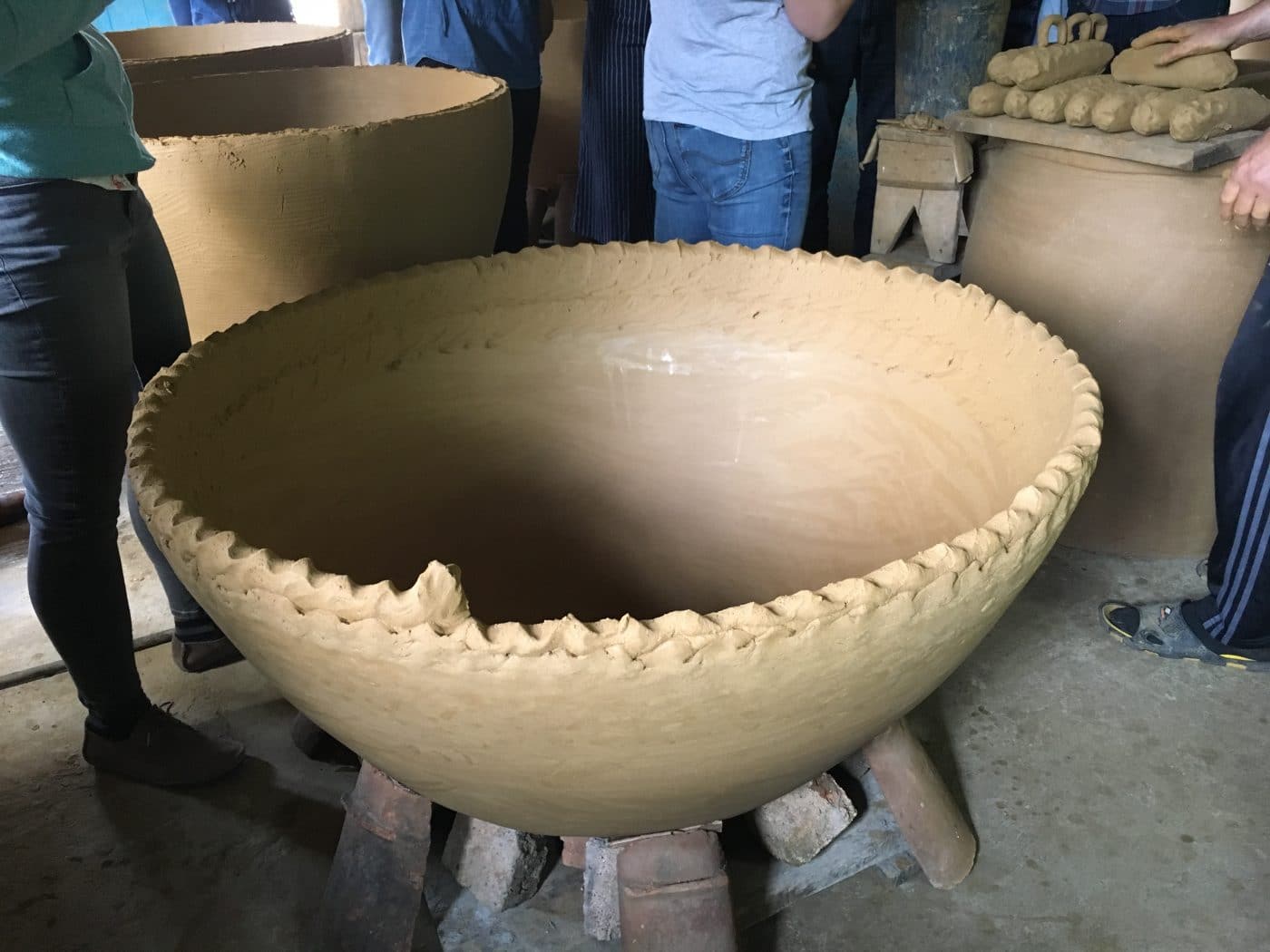
Fresh clay, ready to be added, can be seen in the top right-hand corner. Photo Phyl Doppelt.
First, a wooden frame is made to support the qvevri. Clay is prepared and rolled into coils, and each coil is incrementally added 10 centimeters at a time to maintain the correct tension and strength that will hold the shape and weight of the clay. The fired qvevri must also be strong enough to hold the weight of large volumes of wine. Everything is made by hand, and it can take a lifetime to become a master qvevri maker.
There is no room for error. One crack in the qvevri will lead to a river of wasted wine instead of it being decanted into bottles.
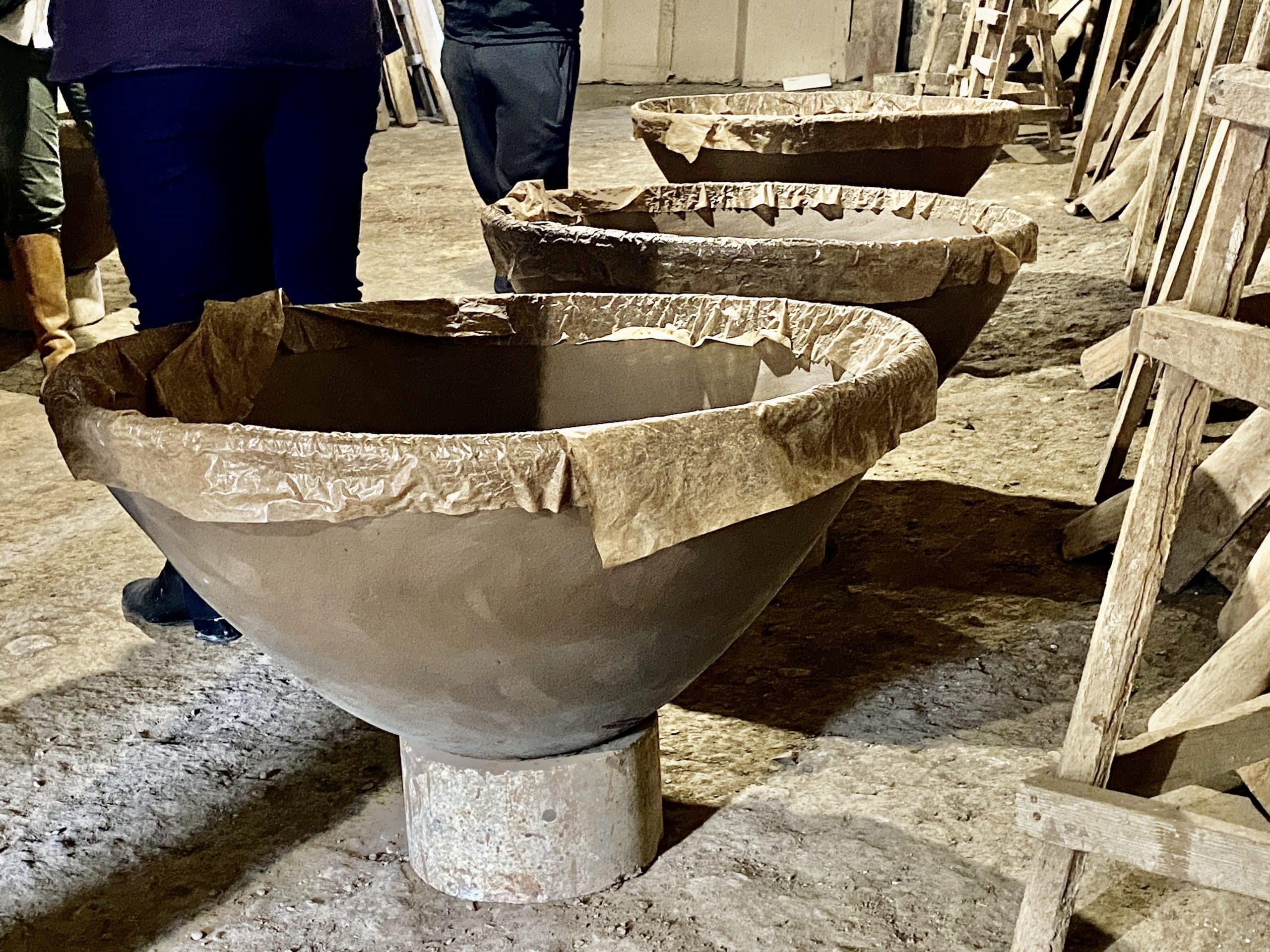
Keeping the qvevri moist prior to adding more clay coils. Photo by Phyl Doppelt.
Depending on the size, each qvevri can take between one and three months to make. Now that I know more about qvevri making, I understand why it takes many weeks to make one of these vessels. To give an idea of its immense size, a qvevri can hold between 13 and 1,000 gallons of wine, it can be as tall as 6 feet high, and the largest could weigh as much as 1,700 pounds.

A large qvevri will need eight men to move it carefully on a special wagon, such as the contraption lined with tires shown in this photograph. The maximum price of a large qvevri is $2,000 – not a great reward for weeks of careful handwork. Considering that qvevri is only made in the warmer months, between March and the end of October, to allow the clay to dry, there is little chance of a qvevri maker becoming a millionaire, not even in the Georgian GEL currency!
Once complete, the Georgian wine qvevri must go into a wood-burning furnace that is sealed to keep the heat in and fed with wood to keep the temperature constant at 1,000 degrees for up to a week. When ready, the surface gives off a hollow sound when “knocked,” the same technique one uses when baking bread! Some of the larger qvevri require special chimneys built to accommodate them, and when ready, the chimney has to be broken to allow them to cool and be removed.

After the firing, while they are still warm, each qvevri is coated on the inside with beeswax. Many wineries have beehives on site for this process. The beeswax smooths and waterproofs the inside and is also antiseptic, making it hygienic – and none of this affects the flavor of the wine!
As the large queries are 6 feet high, the people who clean them have to climb inside to scrub the interiors using special handmade “tools” and brushes. The same goes for lining the interiors with beeswax. It can be very dark inside a huge qvevri, so this is no occupation for the claustrophobic!
They are truly extraordinary feats of ancient engineering, so it’s no surprise that in 2013, this process and the making of Qvevri wine was added to the UNESCO Intangible Cultural Heritage list.
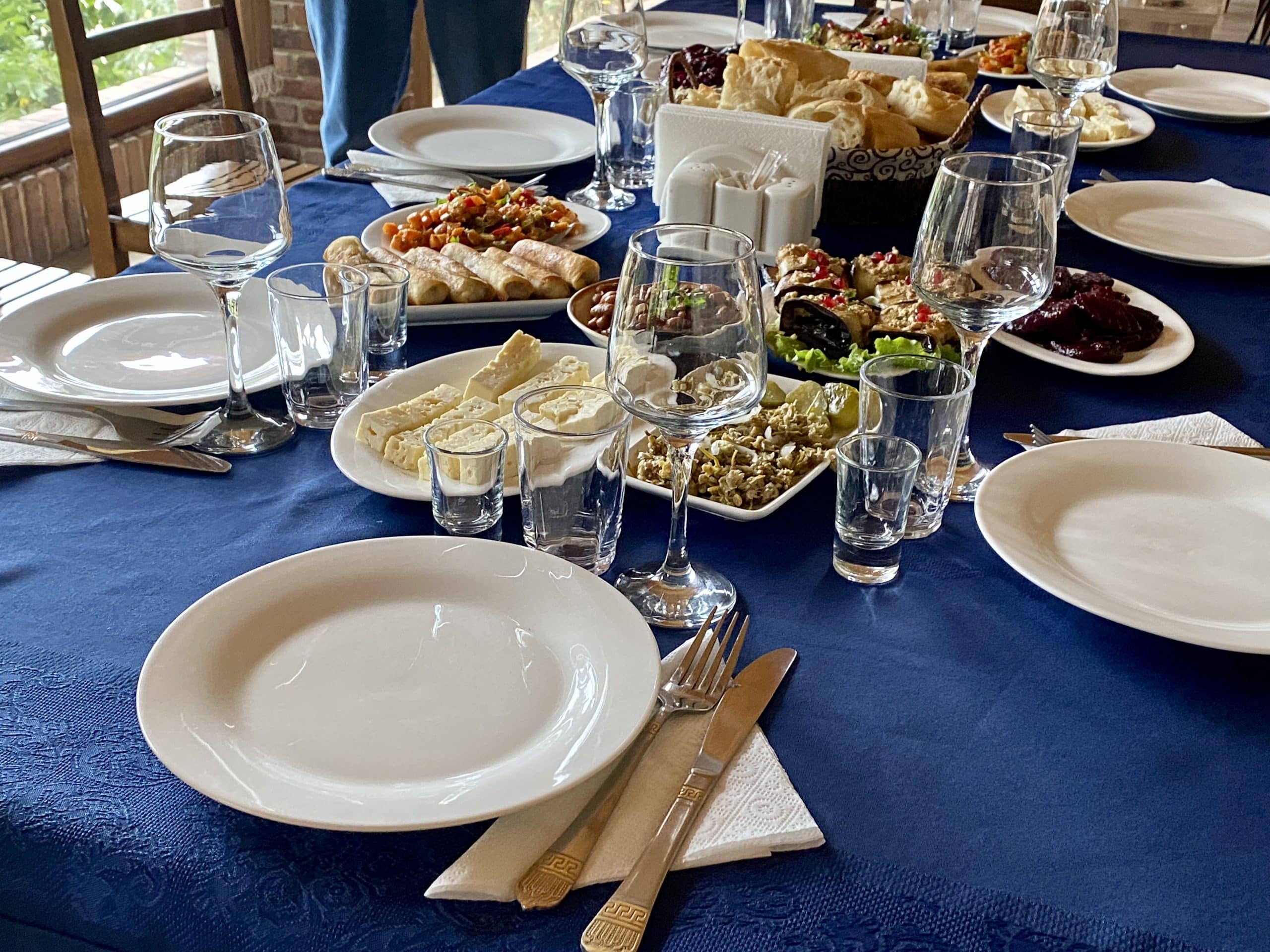
LUNCH AT ZAZA’S HOUSE.
In Georgia, wherever there is wine, there is food, and vice versa, and we did not leave Zaza’s house until he and his family had served us a generous lunch with a wine pairing in the dining room. As is the custom in Georgia, the table was filled with homemade platters of food that included recipes made with the freshest vegetables and fruit, which were all locally grown and prepared in-house: oven-warm homemade bread, several kinds of cheese, salads, and other traditional dishes. We were told not to eat too much at lunch because we would be eating a large dinner, known as a Supra! There is no way to curb your appetite when gazing at one of these food-laden tables. All the food is placed on the table at the same time, with more platters being added during the meal, and it is tempting to taste everything. “Everything” can be 15 to 20 platters – you tell me how one can control wanting to taste everything!
Now that we had learned about qvevris, it was time to learn how to make wine the traditional way in a qvevri. So, we set off on our next experience.
Visiting a Winery in Kakheti.
The grapes, having ripened through the summer, are harvested in the autumn.

When visiting wineries at this time of year, one sees rows of baskets with ripe grapes lined up, waiting to be crushed. This was the scene that greeted us when we arrived at a small winery, which turned into a big experience.

Arriving, the grapes were ready in baskets. We were invited to put on special waterproof boots, and those who wanted to climbed into a trough filled with freshly harvested bunches of grapes and proceeded to stomp. This proved a lot of fun, and I think there was as much laughter as there was stomping.

A tap attached to the trough helped direct the extracted juice, stem, and seeds into containers to be saved for the fermentation process. Photo by Phyl Doppelt.
MAKING THE WINE.
The making of Georgian amber wine in Qvevri is an art form preserved by a handful of modern Georgian winemakers.
Georgia is known for its organic wines, which have been made the same way for millenniums. There is much discussion about amber and “orange” wines – “orange” wine is not made from oranges! The rich amber color, which is sometimes referenced as orange, is derived from the stalks and seeds included in the fermentation process, which impart the rich amber color and unique flavor palette.

In making organic wine, crushed grapes, together with the skins, stalks, and sometimes the seeds, are added to the qvevri – depending on which wine is being made. Mostly, organic wines have no added sugars and rely on the sugars in the grapes to cause fermentation. They are also free of any additives, such as sulfite, which give the wine a longer shelf life, but can cause headaches. Most organic wines are headache-free!

Each blue box is a beehive. The qvevri are lined with beeswax before the crushed grapes are added, and this winery kept its own beehives for this purpose. Photo by Phyl Doppelt.
If the wine is being made in a new qvevri, the inside must be brushed with beeswax, which helps ensure it is leakproof and leaves the interior smooth. If this is a qvevri that has been used previously, then it must be thoroughly cleaned of any grape residue so as not to contaminate the new wine. A combination of water, crushed stones, and grape ash are mixed together to form a paste, and special brushes are used to apply this to the interior. The “cleaners” have to climb into the large qvevri to make sure every particle of the previous wine has been removed. To prove the process was done hygienically, the cleaners are required to drink some water from the cleaning process!
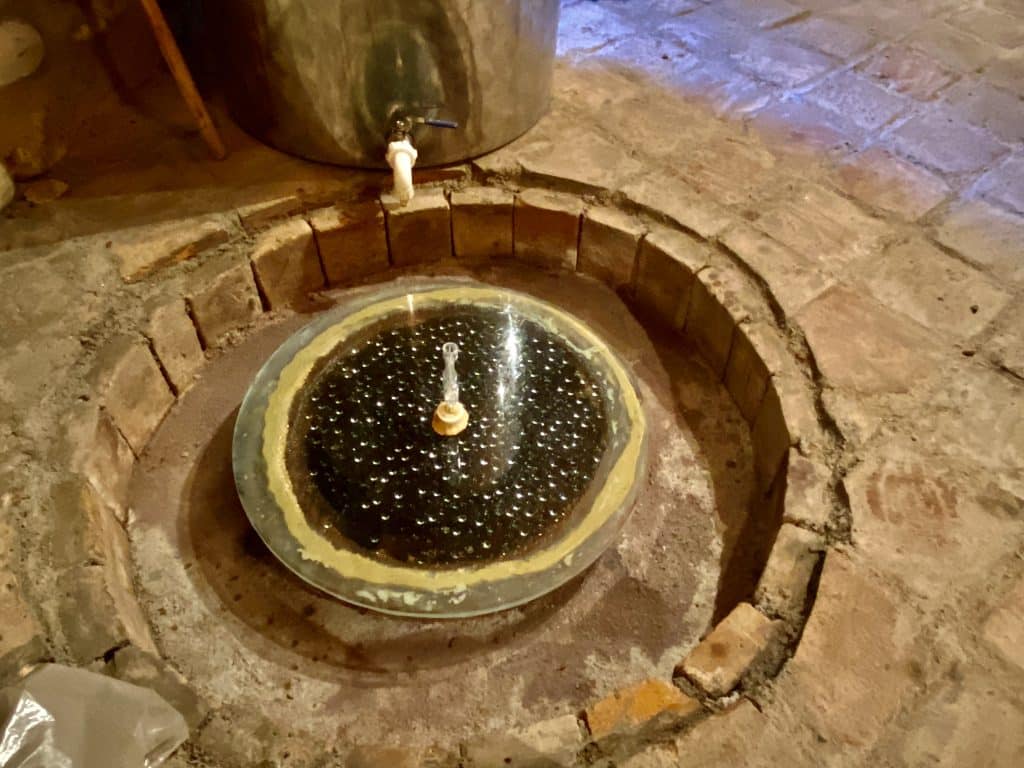
This photo shows the mouth of the qvevri with the lid before it is sealed. The rest of the qvevri is underground, where it will maintain a constant temperature of 53 to 59 degrees Fahrenheit for the natural yeast to accelerate the fermentation process. When all the ingredients are inside the qvevri, it is buried up to its neck underground. Initially, the qvevri is not sealed. The liquids will be stirred with special tools that move them around correctly to encourage fermentation. Once fermentation begins, the vessel is then sealed with a clay layer over the stone lid to make it airtight. The fermenting wine can be left in the qvevri for four weeks to six months, depending on the wine the vintner wants to produce.
Indigenous grape varieties such as Saparavi, Rhatsiteli, and Mtsvane are used in this process. The combination of Indigenous Georgian grapes and the underground process of making wine in qvevri contributes to the unique flavors of Georgian wines.
THE GROWTH OF NATURAL, SULFITE-FREE WINES IN GEORGIA.
During our visit to Georgia, we sampled a wide variety of wines, including white, amber (or orange), and reds. The interesting takeaway was that people did not experience any aftereffects or hangovers after drinking organic wine.
Why is this?
Many Georgian wines are organic, meaning no extra additives or sulfites are used, and the grapes are pesticide-free. Sugar is necessary for fermentation, but Georgian organic wines have less sugar and rely more on grape juice for sweetness.
The Supra.
At the end of the afternoon, we were treated to a Supra. This is a huge celebratory dinner that is led by a tomada. The tomada, or toastmaster, is a charismatic person who proposes several toasts during dinner on different subjects. It may be to the host, to the wine, to next year’s harvest, to the grapes, to the neighbors, to God, and on and on. Following the toast, everyone holds up their glass and takes a good sip of wine. Our toastmaster, Tsotne, was also our guide and interpreter, and he kept the toasts coming even though he had already been toasting for a few previous days.

The table was weighed down with food. Everything was made at home, using fresh, organic ingredients. The chicken was barbequed on the outdoor barbeque and was delicious. As we ate, more platters of food were brought out, accompanied by Georgian wines made in their small winery.

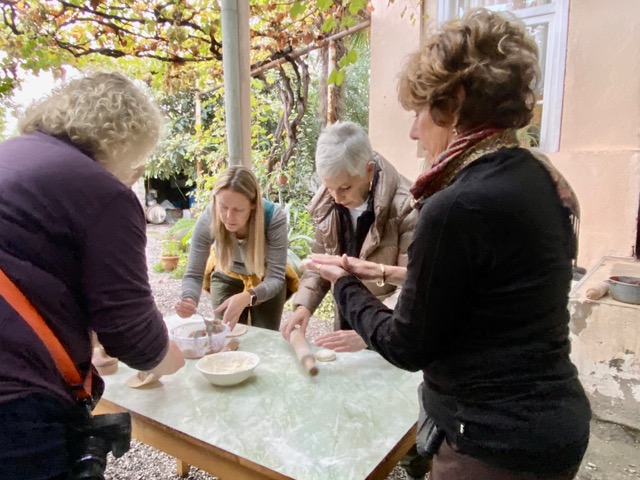


During the afternoon, we watched a demonstration and tried our hand at making khinkali, pleated dumplings that require quite a lot of skill to make. All the examples were saved and then served at dinner. The result was khinkali that lacked uniformity, but as the ingredients were good, they were, as usual, delicious.
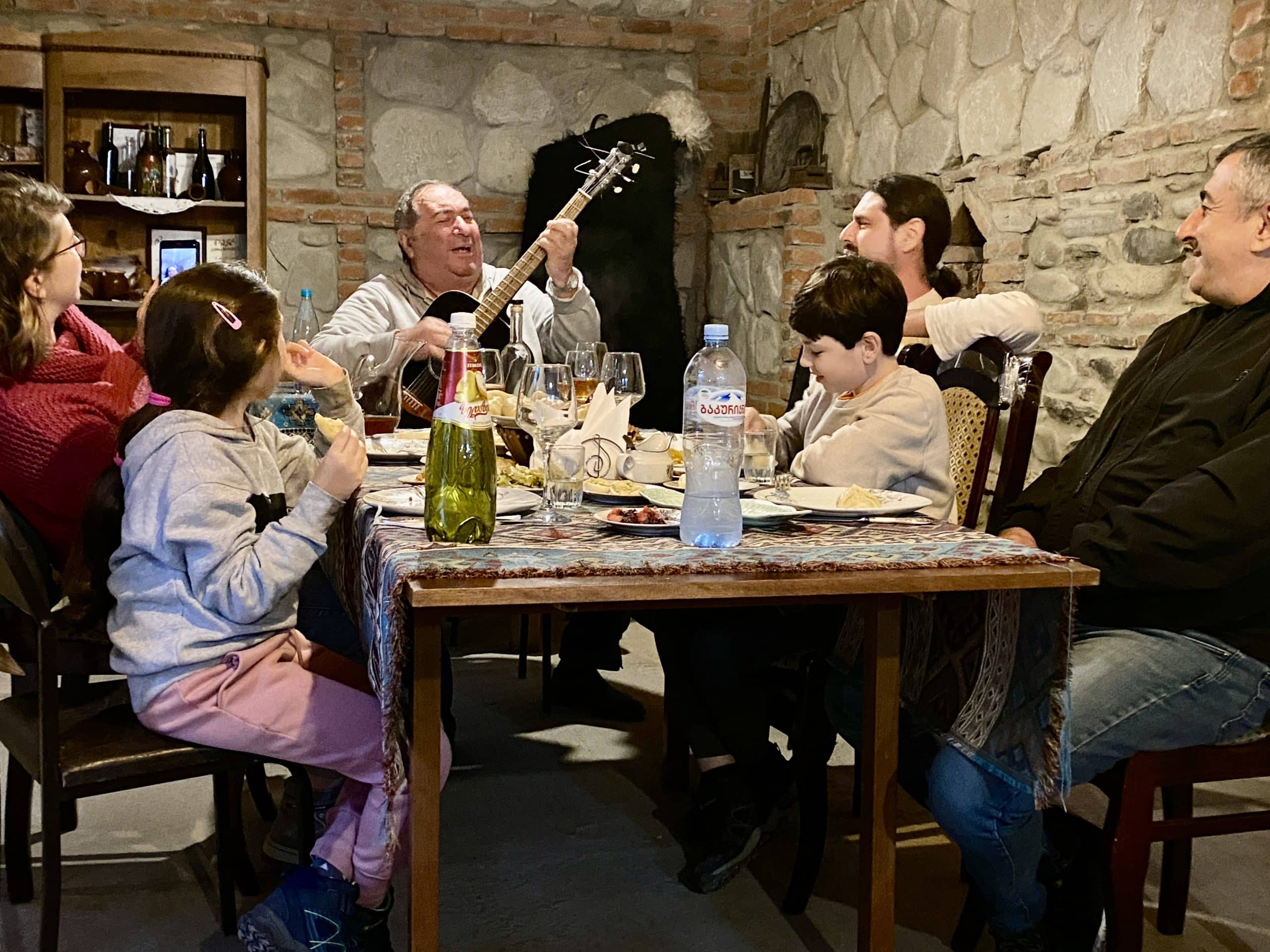
The winery owner fancied himself a rockstar and performed a lot during the Supra. He accompanied himself on the guitar, and as the evening wore on, he became louder and more boisterous.
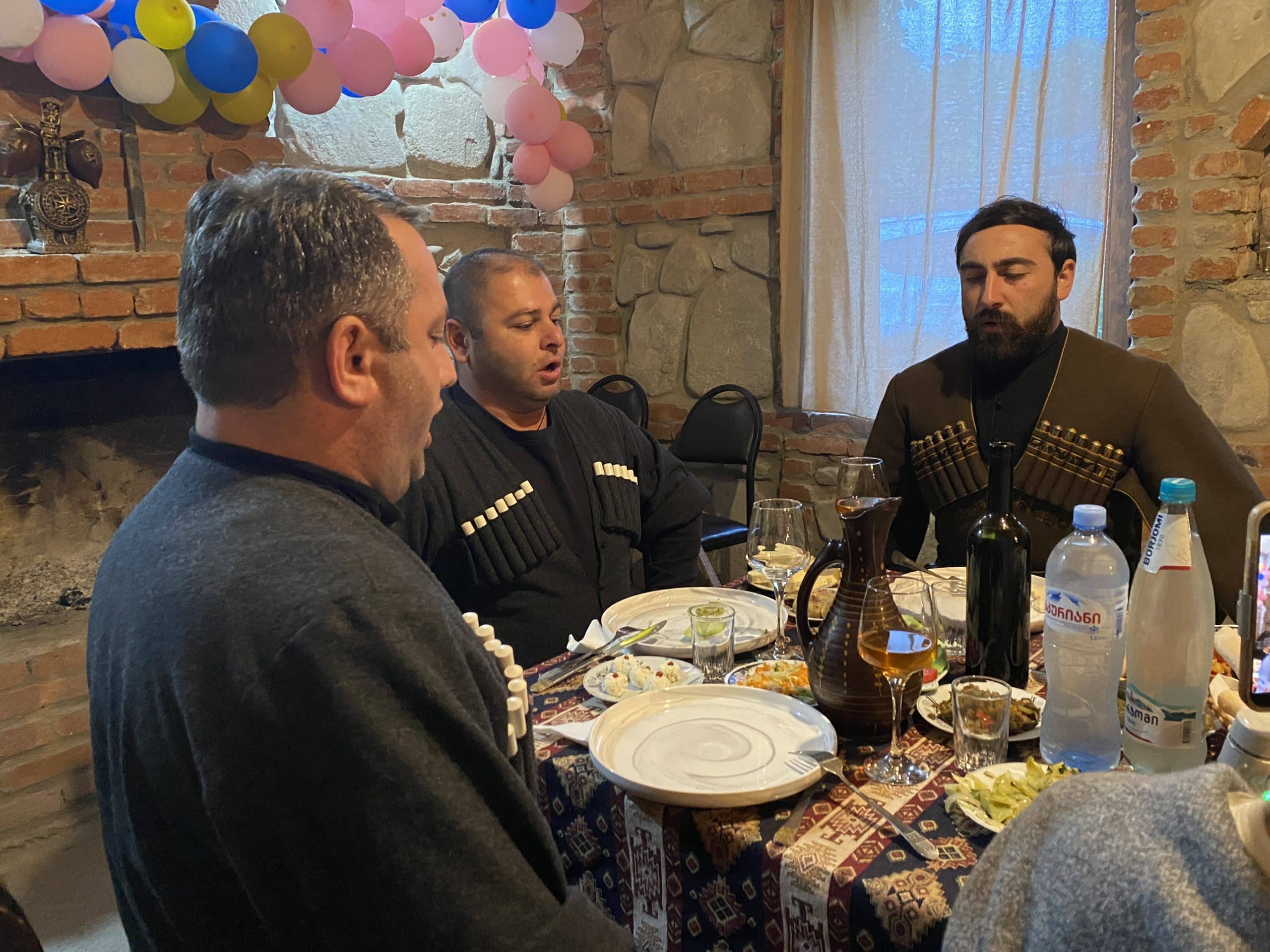
But the best entertainment was from the polyphonic singers seated at the end of the table dressed in national costume, who burst into song from time to time, singing traditional Georgian music. Polyphonic singing is a rich Georgian tradition.

CONCLUSION.

This was an unforgettable day spent immersed in Georgian wine culture and history that goes back to 8000 BC when wine was first made in Georgia, The wine country is extraordinarily beautiful, and the people who inhabit it are warm, kind, and generous, and their hospitality knows no bounds. Learning about organic wines and the way they are made was a unique experience, and the passion the winemakers bring to their craft is being reflected in the increasing demand for Georgian wines on the international market. This was a day where food, wine, history, and culture came together in the “Cradle of Wine,” creating memories that will last a lifetime.
What I learned about Georgian wine and the process was incredible as were the people. I invite you to visit to experience it for yourself!
All arrangements for this tour were made through:
EAT THIS! WINE and FOOD TOURS.
Thomas Williams.
email: bookings@eatthistours.com
mobile: 011 447 855 6482 and 995 511 105 991
Wonderful story! Charming, insightful…
What skills required to make the wine the Georgian way.
And the food looks luscious.
Looks like this was truly a Bon Voyage.
Annie,
Thanks for reading.
It was a dream of mine to visit Georgia — and it more than lived up to the dream — it exceeded it
Thanks for your geneerous comments.
Much appreciated,
Phyl